

Chapter 01
Why we needed a place of our own
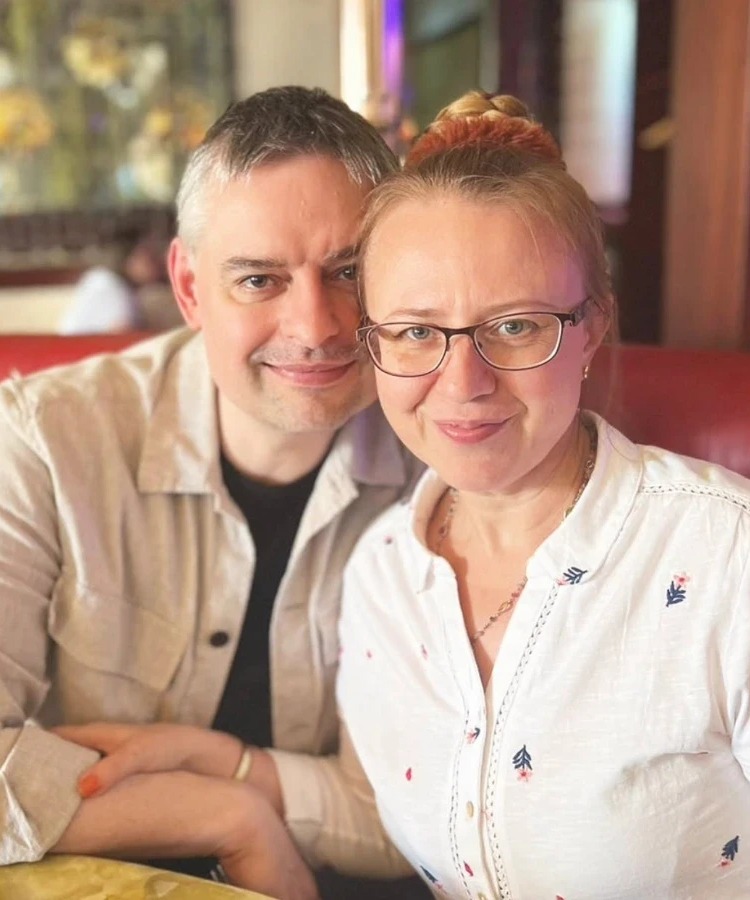
We are Lena and Dima Klein. We have been together for more than thirty years and have three grown-up children. Twenty-five years ago we moved to Europe from Kazakhstan, and in recent years we have lived and worked in Germany, running a small boutique hotel in a forest resort area of Northern Bavaria - a big old house that we renovated and rebuilt ourselves, together with our children
The first social networks arrived during our first years as immigrants - when life in a new country, without old friends and connections, was especially hard and lonely. They gave us conversation, friends and shared projects
Now we are selling the house and the business to devote ourselves fully to a long-held dream - to create such a place online again. It is not a business plan, of course. It is our honest attempt to answer the changes
Chapter 02
What the web promised
Twenty years ago it seemed that technology would give us even more ways to meet people, talk and do things together. It turned out differently. Feeds became closed algorithms where hype and outrage engage better than a calm conversation
Slogans instead of meaning, fear instead of hope, mutual accusations instead of trust. We don't want to lose what we came online for: meeting people, helping each other, talking to a person rather than to a feed
Chapter 03
The world changes faster than we can understand it
We believe a cultural singularity has already begun: familiar pictures of the world, work, identity and the ways we trust information are changing faster than we can get used to them
This is our interpretation of the times, not a scientific forecast of when superintelligence will arrive. We try to tell apart what we see ourselves, how we understand it, and what might only happen. But even without an exact forecast it is clear: the things we are used to leaning on can change very quickly
Chapter 04
What change switches on in us
When everything around is frightening and unclear, an ancient mode switches on in a person: the world splits into us and them, and one craves simple explanations, a clear enemy and a strong leader. This mode lives in each of us. It is not evil and not anyone's ill will. Evil begins when it accelerates: indifference, hostility, dehumanisation, violence
Networks built on attention flip this switch again and again: fear, anger and the image of an enemy spread faster than a calm conversation. So we found ourselves back in a tribe around a fire. Only now the fire is a screen, and the tribe spans the whole world
That is why the appeal «be kinder» doesn't work. Unconditional openness is defenceless in such an environment: it simply gets used. A more mature answer is needed: trust that can defend itself, and an environment that helps such trust
Chapter 05
Why we need to prepare now
We can't stop change, but we can prepare for it - learn, stay independent, build relationships of trust and friendship, support each other. Not just to survive, but to create a life worth going through the changes for
We shouldn't hide from technology and become digital hermits. We should use the possibilities of the future - for our own good and for each other's
Chapter 06
The answer of Buddyalism
For many years we tried to build communities - through art projects, blogs, local groups - and every time we ran into the same thing: shared interests don't guarantee friendliness if people don't share values on a personal level
That is how Buddyalism appeared more than ten years ago: any two people can become friends if they put mutual effort and time into it. Hence the rule - treat any person as a potential friend and act so as to keep that possibility open
Trust grows from reciprocity and burns out from exploitation
Buddyalism inherits from humanism the unconditional value of a person - and answers its vulnerability. The first step towards someone is a free choice, but continuing a relationship requires a response. And no one is ever put outside the moral space or given a final verdict
Chapter 07
The image of Noon
The Noon Universe of the Strugatsky brothers is, for us, an image of a future where people are busy with discovery, creation and each other. It is not a manual and not a promise of utopia, but a direction worth looking in
Chapter 08
Why it needs its own space
Ethics has to be supported by design, not only by a slogan. That is why in Noonland everyone has a Journal, Dreams and Projects; there are no public like counters; a support circle can gather around a dream or a project; the rules forbid hate, trolling and unsolicited criticism, and the system gently warns about harsh comments before moderators step in
Members' data is not for sale - that is a matter of principle. AI can help people, but it shouldn't quietly replace them
Chapter 09
Who is building it and what exists now
We are building the platform ourselves, the two of us - with our own money and the voluntary support of friends. A working version is already available, a lot is still growing, and we count on your help in shaping what it becomes
We don't promise it will be easy or that we will “change the world” right away. It is a long road, and we will get as far along it as we can together
Chapter 10
An invitation
Noonland is not a startup and not an attempt to “replace Facebook”. It is a way to find people you'd love to become friends with, and to build a community together for growth, creativity and life. No more, but no less
No heroics, money or oaths required. Come and get to know us - let's make Noonland a home together
✦ Read more
Texts in which we explain the ethics, the design of the project and what is happening in the world in more detail
Compendium of BuddyalismOur ethics in full~10 min→Project White PaperThe whole picture: from ethics to platform design10-12 min→“Civilization vs. the Chthonic”A programmatic essay about a time of change15-17 min→The Parochial DefaultThe scientific case45-60 min→